From Edwin Drake’s 69.5-foot well in 1859 to today’s two-mile-deep Permian wells, here is the 250-year history of oil drilling breakthroughs that made America energy dominant.
In 1859, the first American oil well reached 69.5 feet. Today a single Permian Basin well can run about two miles straight down and another two to three miles sideways. That leap did not happen by luck. As America marks its 250th year, it is worth remembering that our energy story was invented one breakthrough at a time, and most of them ended up pointing at West Texas.
Key Takeaways
The first modern U.S. oil well, drilled by Edwin Drake in 1859, went just 69.5 feet deep (AOGHS).
The Permian Basin now produces 6.6 million barrels a day, 48% of all U.S. crude oil in 2025 (EIA).
Every big innovation did the same job: it let drillers reach oil that was out of reach before.
How has oil drilling changed in 250 years?
The short version: drilling went from a chisel on a rope to a steerable bit guided by real-time data. In 2025, the United States produced a record 13.6 million barrels of crude a day (EIA), a number unthinkable in Drake's era. The path ran through five turning points: cable tools, rotary drilling, directional and horizontal wells, hydraulic fracturing, and the shale combination that made the Permian the most productive oilfield on earth.
Every one of them extended reach. Deeper, through harder rock, or farther sideways. Hold that idea and the whole 250 years snaps into focus.
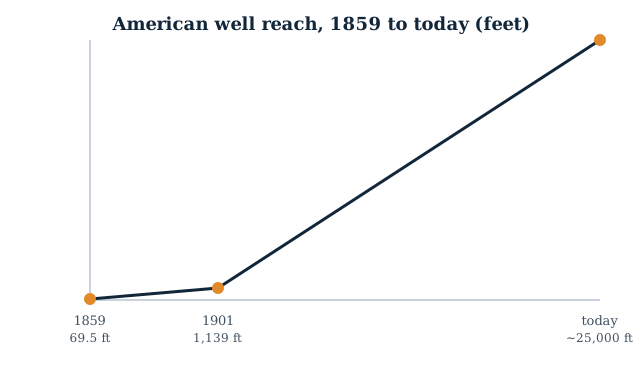
Reach shown as total borehole length; the modern figure is an approximate long-lateral Permian well. Sources: AOGHS, EIA.
The cable-tool era: America's first oil wells
Americans were drilling before anyone drilled for oil. In the early 1800s, salt-brine drillers pounded holes with a spring pole, a springy sapling that lifted and dropped a heavy bit on a rope. It was slow, sweaty, and clever. Then in 1859, Edwin Drake put a steam engine behind that idea near Titusville, Pennsylvania, and struck oil at 69.5 feet (AOGHS).
Drake also drove a pipe down the hole to keep it from caving, a trick still used on every well drilled today. Seventy feet sounds tiny now. In 1859 it started an industry.
Rotary drilling, mud, and a better bit
The cable tool pounded. Rotary drilling turned. That change, cutting rock with a spinning bit instead of chiseling it, is why a well can now be finished in days rather than months. It proved itself on January 10, 1901, when the Lucas Gusher at Spindletop, near Beaumont, Texas, blew oil more than 150 feet in the air from 1,139 feet down, flowing an estimated 100,000 barrels a day (Texas State Historical Association).
Two quiet helpers made it work. Drilling mud stabilized the hole, cooled the bit, and carried cuttings up. And in 1909, Howard Hughes Sr. patented the roller-cone bit, which finally chewed through hard rock that had stopped rotary rigs cold.
Learning to steer: directional and horizontal drilling
For most of that history, wells went one direction: straight down. What if you could aim them? Directional drilling took hold in the 1930s, and by the 1980s crews could turn a wellbore until it ran flat, sideways, through a target zone. Steering a bit two miles underground is now a specialty of its own, one of many trades you will find among Permian directional drilling crews.
Why does sideways matter so much? Because a lot of oil sits in thin layers of rock. A vertical well pokes through that layer in a few feet. A horizontal well can travel through it for two miles, touching far more oil. That single idea set the table for everything that came next in the Permian.
Fracturing plus horizontal: the shale revolution and the Permian
Some rock holds oil but holds it too tightly to flow. Hydraulic fracturing fixes that by pumping fluid down the well to crack the rock open. The first commercial frac job ran in 1949, but it stayed expensive for decades. Then, in the late 1990s, Mitchell Energy proved out a cheaper slickwater frac in the Barnett Shale, and the economics flipped.
Pair that with horizontal drilling and you get the shale revolution. Basins written off as played out came roaring back, none louder than the Permian. Its stacked layers of oil-rich rock made West Texas and southeastern New Mexico the center of it all. By 2018 the United States was the world's largest crude oil producer (EIA), and in 2020 it became a net petroleum exporter for the first time since at least 1949 (EIA). Today the Permian alone pumps 6.6 million barrels a day, 48% of U.S. output (EIA). Political independence in 1776, energy independence in our own lifetime, drilled one foot at a time by Basin crews and operators.
What comes next: the digital oilfield
The next 250 feet are being drilled by software. Rigs now steer bits with real-time downhole data, automate the rig floor, and use AI to keep a lateral inside a rock layer only a few feet thick. Laterals keep getting longer and wells get drilled faster. The tools change fast. The goal has not changed since 1859: reach a little more of what is down there, a little more efficiently than yesterday.
Frequently Asked Questions
When was the first oil well drilled in the United States?
Edwin Drake drilled the first modern U.S. oil well near Titusville, Pennsylvania, in 1859, reaching 69.5 feet with a steam-powered cable-tool rig (AOGHS). He also pioneered driving pipe to keep the hole open, a method still standard today.
What innovation started the shale revolution?
The shale revolution came from combining two technologies: horizontal drilling and slickwater hydraulic fracturing. Mitchell Energy proved the cheaper slickwater frac in the late 1990s, and pairing it with horizontal wells in the 2000s unlocked oil that vertical wells could never reach economically.
Why is the Permian Basin so productive?
The Permian holds thick, stacked layers of oil-rich rock that horizontal drilling and fracturing can tap efficiently. In 2025 it produced 6.6 million barrels a day, about 48% of all U.S. crude oil, making it the most productive oil region in the country (EIA).
Conclusion
Sixty-nine and a half feet to two miles down and three across. That is the story of American oil in one sentence, and it took 250 years and a stack of stubborn inventions to write it. Energy independence was not handed to the country. It was drilled, foot by foot, and much of it under West Texas.
The crews and companies carrying that legacy forward are working the Basin right now. Browse them in the Oilfield Pros directory, or list your company and join them.